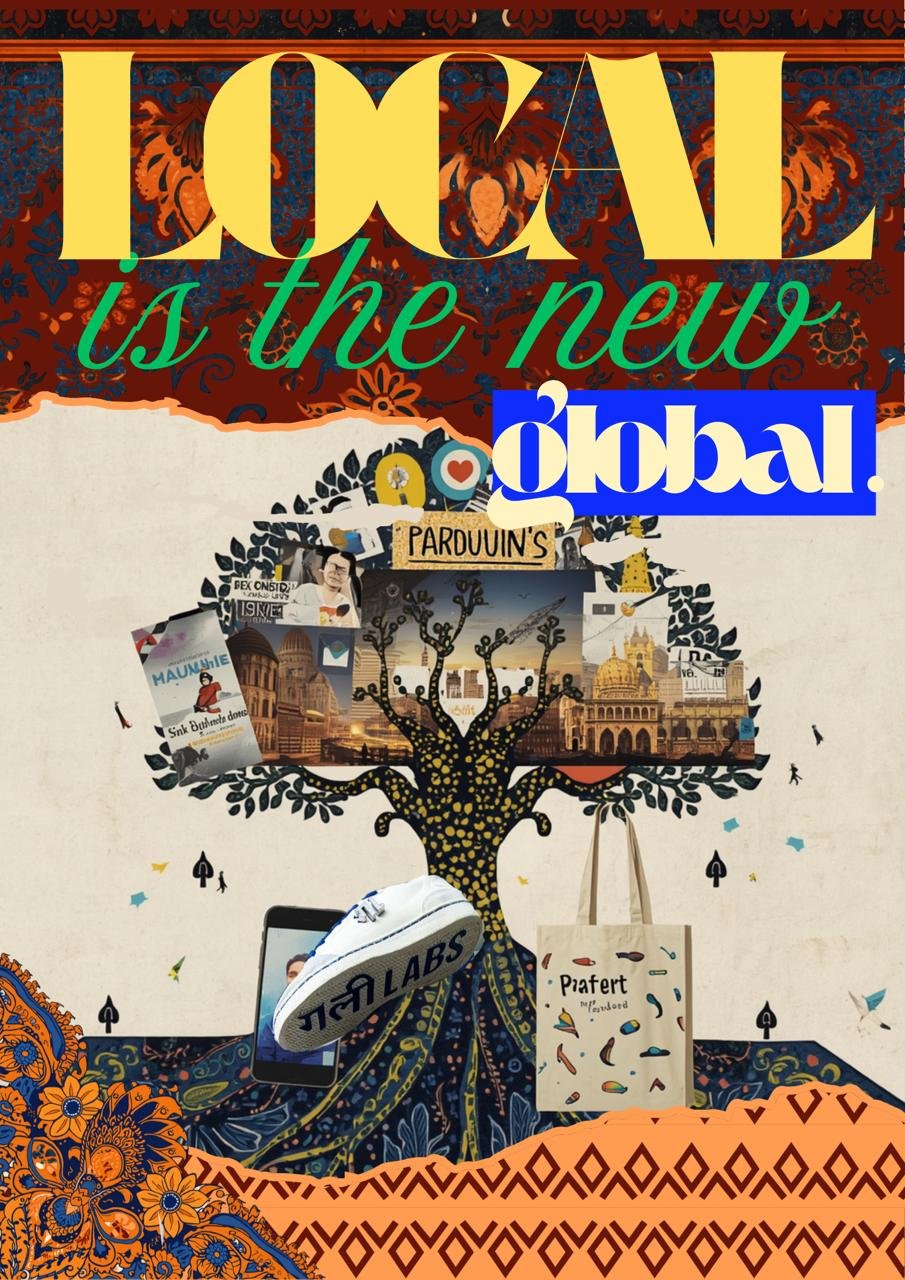
When a generation values identity over ownership, markets must adapt.
377 Million
Gen Z consumers in India — the largest such cohort in the world
$860 Billion
Current consumer spending driven by Indian Gen Z
$1.3 Trillion
Projected Gen Z consumption by 2030 (Redseer)
$100 Billion
India's D2C market size in 2025
Chapter 1 — The Question That Nobody Asked
It was the year 2023. A banker named Arjun Singh left not only his job at JP Morgan but also his home in Sydney. He flew back to Delhi with dreams one would never expect. He returned to make sneakers. Not imported sneakers. Not licensed sneakers. Sneakers stitched by hand, which were inspired by Indian motifs. Handmade by karigars in a workshop in Noida, which he called his laboratory.
It was the year 2025. Gully Labs not only raised ₹8.7 crore in seed funding but also sold out a limited drop in under six minutes. It had been featured on CNBC TV18's Swadeshi series.
These sneakers cost more than a pair of Reeboks, yet they sold out faster than most Reeboks ever do in India.
The pressing question is: why? Or more importantly, how?
The most obvious explanation is marketing. However, there is a deeper reasoning behind their success. That reasoning is economics. Specifically, it concerns a structural shift in what Indian consumers in their late teens and twenties now consider before buying any good.
India's Generation Z, comprising roughly 377 million people born between 1997 and 2012, is the largest youth population in the world. It is also the first generation in all of Indian economic history to have grown up with smartphones rather than with an aspiration to own foreign goods. For older generations, a Nike swoosh or an L'Oréal label was the only implicit promise of the global: modern, quality-certified, and aspirational. However, for Gen Z, that promise has curdled into something that one could almost call generic. Their wants now are hard to manufacture and even harder to copy. They want proof that a brand understands who they actually are.
That shift from aspiration to identity is single-handedly causing the most consequential demand-side change in the Indian consumer economy in recent times, as consumers increasingly seek brands that reflect their personal values and lifestyles. And the brands that have grasped it are not the legacy giants that have been around forever. They are scrappy, digitally native, mostly founder-led companies built by people who either belong to this generation or have watched it closely enough to understand its needs.
Chapter 2 — The Birth of a New Market
Let's begin with macroeconomics to truly understand what is happening. India's private consumption nearly doubled from $1 trillion in 2013 to $2.1 trillion in 2024. The country recorded 185.8 billion digital payment transactions in FY25 alone, with UPI accounting for 83.4 per cent of that, spreading across a base of one billion internet connections and 260 million online shoppers. This is not just a market becoming digital, but a market that has already crossed that threshold and is now thriving and growing within it.
At the centre of this thriving market lies the direct-to-consumer business model (D2C). India's D2C market, which was earlier forecasted to reach $60 billion by 2027, reached $100 billion in 2025. Conservative estimates have been made, and it is now put at $267 billion by 2030, at a CAGR of 25 per cent. India now hosts approximately 11,000 D2C companies, which accounted for nearly 18 per cent of all retail space leased in 2025. These are not startup vanity metrics; rather, they represent a fundamental restructuring of the supply chain where the wholesaler, the regional distributor, and the multi-brand retailer are being systematically disintermediated.
The economic logic behind D2C is simple yet powerful. It cuts out the intermediary, which not only allows brands to earn a larger share of the consumer rupee but also collects first-party data that was previously inaccessible. However, the biggest advantage of this model is the quickening of the feedback loop between producers and consumers, from quarters to mere days. For a consumer base that expects new drops weekly, this operational agility is not just a differentiator but table stakes.
— Praxis Global Alliance & IndianRetailer.com, IReC × D2C Summit 2025
Chapter 3 — Putting Theory to the Test
The brands winning in this environment all share a quality that is difficult to get across in a pitch deck but is immediately understood by the target consumers. They are built on cultural honesty. They do not perform "Indianness" but are rather constituted by it.
Let's take Snitch, the Bengaluru menswear brand that could be rightfully called the most economically dramatic story of the generation. It was founded in 2019, first as a B2B garment supplier, but it pivoted to D2C in 2020. A pandemic-era decision that could not have been better timed. In 2022, the revenue was ₹11 crore. But by FY25, the revenue crossed ₹520 crore, which was a 47x revenue growth in four years. It has over 51 profitable stores and a valuation of ₹2,500 crore, all achieved within 4 years. Snitch built its influence through nano and micro-influencers, not aggressive discounting or celebrity endorsement. They paid hundreds of creators with between 1,000 and 100,000 followers who produced real-world styling content that Gen Z audiences trusted simply because it did not feel like advertising. Design cycles were fastened to 15–20 days with new drops related to trending audio, memes, and cultural moments. The brand didn't just follow fashion but rather the internet, which for Gen Z consumers is the flow of culture itself.
Rimjim Deka and Partha Kakati started Littlebox, a brand for women's clothing, in 2022. It has a 25-day inventory cycle and adds 100 new styles every week. Its demand-forecasting algorithm keeps dead stock to a minimum, which is something that older retailers can't do. In 2025, it made ₹17.5 crore. Bonkers Corner started in 2020 and built a streetwear brand around gender-neutral fits, oversized shapes, and licensed pop-culture collaborations with Marvel, Disney, and Hello Kitty. The brand has since grown to 19 exclusive stores in India's major cities without ever running a traditional print campaign. The two brands have something in common besides their growth numbers: they both made a conscious decision about whose world they were designing for and stuck to it.
A similar story may be found in the footwear business. Eco-conscious urban Gen Z consumers have developed a devoted following for Thaely, a company that makes trainers from recycled plastic bags and upcycled materials. Ten years ago, this market segment was nonexistent. At a time when both were becoming identity markers rather than product features, Neeman's, which is based on merino wool and natural fibres, positioned itself in the space between performance and sustainability. By FY32, the Indian trainer market is projected to grow from its FY24 valuation of $3.88 billion to $6 billion. As recently as 2020, it would have seemed unthinkable that India is now the second-largest hotspot for D2C sneaker startups worldwide, after the United States.
2.5 million digital producers are already influencing over $350 billion in annual consumer expenditure, which is expected to surpass $1 trillion by 2030, according to a BCG analysis published in 2025. In 2024, YouTube's creative ecosystem alone boosted India's GDP by more than ₹16,000 crore.
Importantly, compared to the global average of 65 per cent, 83 per cent of Indian Gen Z consumers identify as content creators. Economically speaking, this is significant since it indicates that the distinction between distributors and consumers has essentially vanished. There is a non-trivial chance that a Gen Z customer who buys a pair of Gully Labs trainers will also record an unpacking reel, upload a styling video or create a review thread. At the same time, the marketing channel is the consumer. This is a compounding benefit for companies that are based on cultural authenticity: Genuine fans' organic content has a legitimacy that paid advertising, no matter how much it costs, cannot match.
As a result, influencer marketing's economics have changed. According to the BCG analysis, in the near future, brand spending in creator marketing is expected to rise by up to three times. The more significant change, however, is qualitative: brands are shifting from a broadcast model—one message, one celebrity, millions of passive recipients—to a network model, where hundreds of smaller, more focused voices produce content that reaches smaller but much more responsive audiences. Because its community handled a large portion of the distribution, Snitch's marketing expenses decreased by 50% in FY25 while income almost doubled.
Chapter 4 — Shift in Beauty and Finance
Fashion is not the only area where identity-driven demand is changing. The disruption has been equally noticeable in skincare and cosmetics. While traditional FMCG companies recorded single-digit growth during the same period, India's D2C beauty business expanded by 88% in 2024 to reach $2.1 billion in revenue. One thing unites the brands that are propelling that expansion: they communicate clearly.
Transparency was the cornerstone of Minimalist's entire marketing strategy, which included labelling serums with the percentages of active ingredients, eschewing aspirational iconography, and setting prices about 40% lower than those of comparable formulas in other countries. In 2024, it increased by 300 per cent annually. Sugar Cosmetics, which today generates over ₹600 crore annually over 40,000 retail touchpoints, developed hues and formulations particularly calibrated for Indian skin tones, an apparently easy move that legacy corporations had mostly failed to execute. mCaffeine, which generated over ₹150 crore in revenue in 2024, was founded on caffeine-based personal care for youthful, active consumers. In each instance, the brand's main selling point was essentially a kind of cultural acknowledgement: "We see you, we made this for you, not for a projected idea of who you should want to be."
The change is even seen in financial behaviour. According to PhonePe's Share.Market platform, between August 2024 and July 2025, roughly 48% of its mutual fund investors were between the ages of 18 and 30. Ninety-two per cent of them opted for SIPs, with an average monthly investment of ₹1,000. According to NSE data, about 69% of Indian stock market investors are under 40. Gen Z is interacting with capital markets without waiting for financial maturity. Compared to preceding generations, they are entering younger, more digitally, and with behaviours that are methodical, low-cost, and long-term.
Chapter 5 — The Risk of Mistaking the Movement
All of this carries some risk. At ₹500 crore in revenue, the D2C model, which works well for founder-led brands, becomes operationally costly. Early growth figures do not show the compounding effects of inventory management, supply chain resilience, customer acquisition costs on mature platforms, and the unit economics of physical retail development. Even though EBITDA increased significantly in FY25, Snitch spent ₹1.02 for every rupee of revenue. The primary strategic challenge facing this generation of brands is scaling authenticity without diluting it, and not all of them will be able to do so.
Another concern is whether incumbents will change quickly enough to offset the impact. The fact that Aditya Birla Fashion launched OWND! in 2025, a quick fashion brand aimed at Generation Z with products under ₹1,200 with a 400-store strategy, indicates that the conglomerates are moving forward. A similar objective is indicated by Trent Ltd.'s Burnt Toast label, which was introduced in the same year. Currently, cultural fluency—rather than capital—is what gives Snitch and Gully Labs an advantage. It is possible to raise capital. It is more difficult to produce cultural fluency at a rate that a procurement committee can approve, the kind that makes a twenty-two-year-old in Lucknow feel as though a brand truly belongs to her world.
— Kotak Mutual Fund, Gen Z Consumption Report 2026
For both investors and economists, the larger structural concern is what happens to a market when cultural identification takes over as the main organising force of demand. According to past price-elasticity data, demand is therefore less predictable. Because lineage loyalty has waned, brand switching costs are paradoxically both lower and higher due to the intensely personal nature of identity identification. It implies that cultural distinctiveness is more important than geography, as a streetwear company in Delhi may find its most devoted client in Coimbatore.
Chapter 6 — The Gully Up
For anyone starting a consumer firm in India today, the unsettling reality is that the previous model was lenient. Spending money could help you build brand awareness. A billboard on the Western Motorway and a famous person's visage could create aspiration. You could rely on the implied promise that familiarity meant loyalty, that scale meant trust, and that foreign meant better. For some customers, that model is still somewhat effective. However, it is losing customers every year, and those who are leaving are the youngest, most tech-savvy, and most valuable individuals in the market.
Brands that have realised this are not waiting to be investigated. Snitch has already launched in the UAE and aims to generate ₹1,000 crore in revenue by FY26. Gully Labs is considering drops for Singapore's and Dubai's Indian diaspora. 40,000 retail touchpoints are operated by Sugar Cosmetics. A multinational that had spent decades marketing the same type of opaque, aspirationally branded product that Minimalist was designed to replace purchased Minimalist for about ₹3,000 crore. The market's strongest indication to date that the disruption is significant enough to warrant purchase is that acquisition.
What follows is not just an increase in the size of the same brands. The entire link between Indian identity and commerce is being renegotiated. A generation that grew up viewing the world on a smartphone screen, learning how to cook from YouTube, how to dress from Instagram, and how to invest from Zerodha, does not view marketers as outside authorities dictating their desires. They perceive brands as mirrors. Those who are true to themselves are retained. Those that are not are scrolled past.
This generation, which makes up 27% of India's population, will want $1.3 trillion in consumption by 2030. In the third-largest economy in the world, they will be the main consumer force. Whether a company is a first-time founder or a heritage conglomerate operating in India, the question is not whether to take them seriously. The question is whether this generation will recognise themselves in what you've created. No amount of marketing funds will close the gap if the response is negative. If the response is in the affirmative, you won't require as much money as you anticipate.
Sources & Data References
Redseer Strategy Consultants, 'Gen Z: Defining Trends, Influencing Spends' · BCG, 'From Content to Commerce: Mapping India's Creator Economy' (2025) · KPMG Asia Pacific & GS1, 'Navigating the Future of Seamless Commerce in Asia Pacific' (2024) · CBRE, 'India's D2C Revolution: The New Retail Order' · Praxis Global Alliance & IndianRetailer.com, IReC × D2C Summit 2025 · NSE Investor Data, June 2025 · PhonePe Share.Market Platform Data, FY25 · Kotak Mutual Fund Gen Z Consumption Report, 2026 · YouTube Culture & Trends Report 2024 · DHL E-Commerce Report 2025 · IMARC Group Indian Sneaker Market Report · Inc42, Entrepreneur India, Indian Retailer — brand-level reporting on Gully Labs, Snitch, Littlebox, Bonkers Corner, Minimalist, Sugar Cosmetics, mCaffeine.
Project Thoughts